How to Stop Buying Beauty Products You Already Own
You get home with a new lip liner and find the same shade, barely used, at the back of a drawer. Or you open a second bottle of the same serum because you forgot the first one was still half full. Duplicate buying is one of the most common ways money leaks out of a beauty budget, and it is easy to do without noticing.
Why it happens
It is rarely carelessness. A few ordinary things cause it:
- You cannot see what you own. Products are spread across a bathroom cabinet, a makeup bag, a drawer and a travel pouch.
- You shop from memory. In the store or scrolling online, you are guessing what is at home.
- Different products do the same job. Three hydrating serums from three brands are still three hydrating serums.
- Sales and sets. A discount on something you already like feels like a saving, even if you have two unopened.
- Backups. Buying a spare "so I do not run out" often means the spare sits for a year.
The hidden cost is expiry
A duplicate costs more than its price. Beauty products have a limited life once opened, and many have a limited life even sealed. Two open bottles of the same thing get used at half the speed, so both are more likely to pass their date before they are finished. Our guide to PAO explains how those dates work.
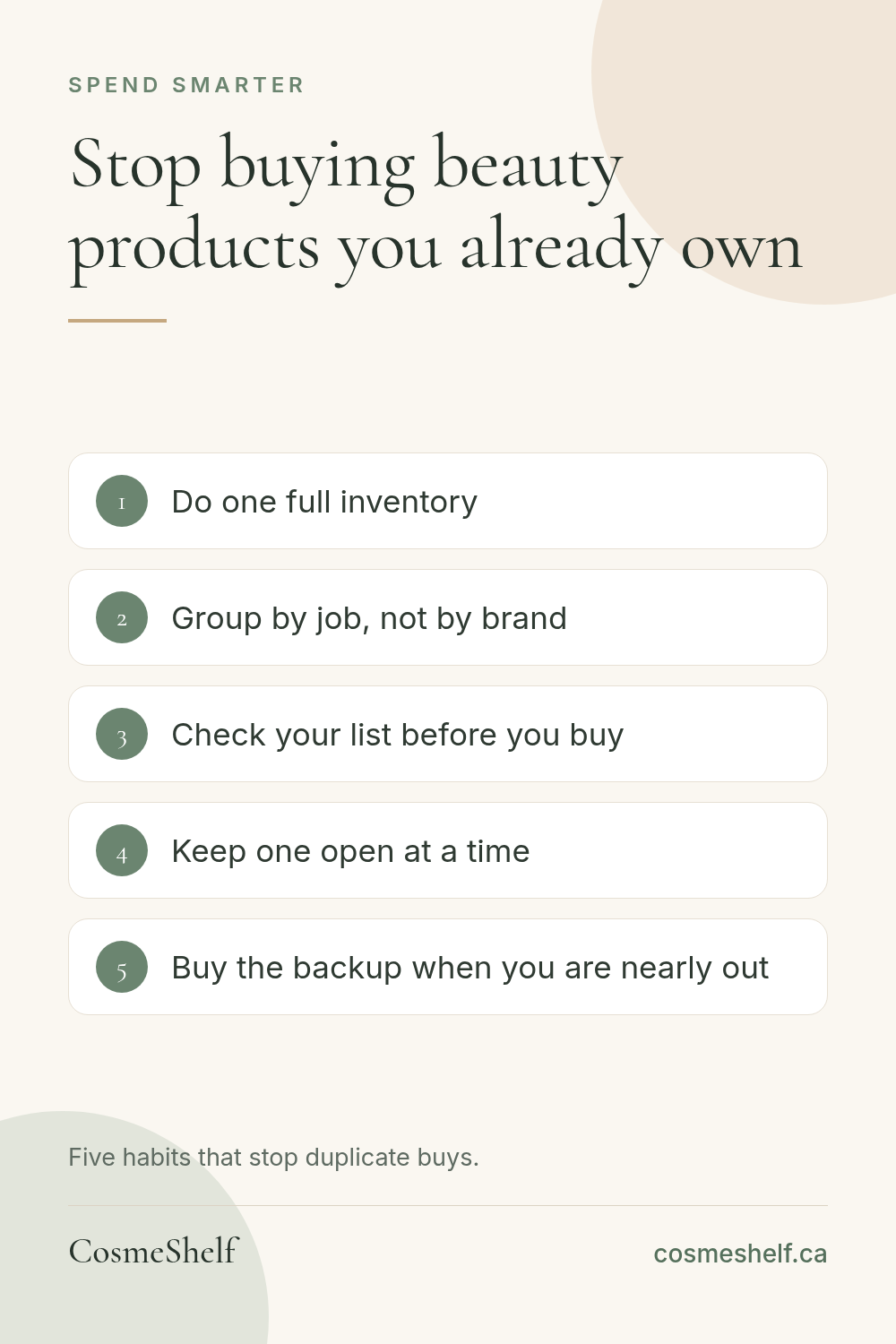
Five habits that stop duplicates
1. Do one full inventory
Gather everything in one place, once. Every bag, drawer and shelf. Group it by type: cleansers together, lipsticks together, and so on. Most people are surprised by at least one category. Write the list down or add the products to an app, because the next four habits depend on having it.
2. Group by job, not by brand
Ask what each product does. If you own four products whose job is "hydrating serum", you have one need and four answers. Decide which you will use first and which can wait.
3. Check before you buy
Before paying, look at your list for that category. It takes under a minute and it is the single habit that prevents most duplicates. Having the list on your phone matters here, because you are usually not at home when you shop.
4. One open at a time
For each type of product, keep one open. Open the next when the current one is finished. This keeps everything fresher and makes it obvious when you really need a replacement.
5. Buy the backup when you are nearly out
A backup makes sense when you are close to the end of something you use daily. It makes less sense months ahead. Try a simple rule: replace when you are down to the last quarter.
What to do with the duplicates you already have
- Unopened and recently bought: check the store's return policy.
- Unopened and in date: give it to a friend or family member, or set it aside as your next one in line.
- Opened: use the older one first.
- Past its date or changed in smell or texture: let it go. See 10 signs your skincare has expired.
Make the list do the work
The list is what makes this stick. A printable inventory page works if you like paper. If you would like it on your phone, you can add your products to a free CosmeShelf shelf and check it from the store. Duplicate Detection, which flags when you add something you already own, is part of CosmeShelf Pro.
Once you can see what you own, setting a spending limit gets much easier. Our guide to building a skincare budget that works is the next step.
Track your skincare with CosmeShelf
Scan, organise, finish. Never waste a bottle again.
Try CosmeShelf free — no account neededKeep reading
How Long Does Makeup Last After Opening?
A product-by-product guide to the periods brands commonly print, and how to find the one on your own makeup.
Stay OrganizedHow to Organize Your Skincare and Makeup Collection
A one-afternoon method to sort, store and keep track of everything you own.
Beauty BudgetHow to Build a Skincare Budget That Actually Works
Stop guessing what you spend on beauty. Start tracking it — and watch your habits change.